Flowering Dogwood (Cornus florida).
Flowering dogwood is a woody, deciduous, showy, understory tree in the dogwood family (Cornaceae) that is native from southeastern Canada through eastern North America to eastern Mexico, where it is commonly found growing in woodland margins. The species epithet is Latin for “floriferous.”
Flowering dogwood can be a tricky plant to grow in a landscape setting. Locate flowering dogwood in a site that receives full sun to partial shade, though in the peidmont and along the coast it may need more shade, especially in the afternoon. Plant in well-drained soil that is high in organic matter and has a slightly acidic to neutral pH. A 2- to 4-inch layer of mulch will help keep the roots cool and moist in hot summers. Propagate flowering dogwood by seeds or stem cuttings.
Flowering dogwood is a small tree 15 to 25 feet tall. The tree is found throughout the state, usually growing under larger forest trees and at woodland edges. It is quite tolerant to heat once established and has a low flammability rating. The showy dogwood “flower” is actually a cluster of small, true flowers surrounded by four petal-like bracts. It is the state flower of North Carolina. The flowers are visited by butterflies and specialized bees, and the red fruits are a food source for songbirds and other wildlife from fall through winter.
Previously known as: Benthamia florida; Benthamidia florida; Cynoxylon floridum.
Identification
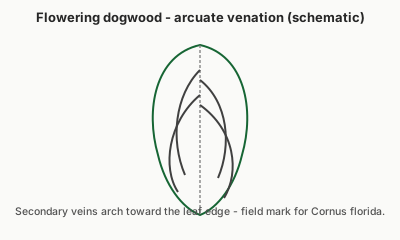
Veins curve from base of leaf to tip. Opposite, simple, oval to ovate, acuminate, cuneate to rotund, entire, dull green above, glaucous beneath and pubescent on the veins, 6 or 7 vein pairs, 2.5 to 6 inches long. The fall color is red to reddish purple.
Attractive, dark gray, brown, or black bark that is broken into small scaly blocks as the tree matures.
Blooms early spring before leaf-out, March-May, the true flowers at the center, are green and insignificant, but are surrounded by 4 petal-like, 2-inch long bracts, notched at the ends, that are often mistaken for the actual flowers. Flower buds are round and flattened at the ends of stems, (many) greenish-yellow; bud is biscuit-shaped, glabrous and flattened, gray-green, at branch ends, covered by 2 large silky scales becoming 2 of the showy white bracts.
Fruit is a glossy bright, shiny red, oval drupes (0.5 inch) in tight clusters of 3 or 4 that are bitter and inedible to humans but loved by birds. They display from August to October.
Habitat and cultural conditions
With multi-season interest, it has many uses in the landscape such as a butterfly, pollinator, or children’s garden, a native or winter garden, accenting a patio or play area, a specimen, or shade tree.
Uses and significance
The Clemson Cooperative Extension Home & Garden Information Center has a factsheet on common pests and diseases.
This plant was used for medicinal purposes by Native Americans, as well as for carvings, looms, and disinfectant. Wood is hard, heavy, close grained and strong. Often used for textile shuttles and spools as well as handles for tools.
It is a host plant for the spring Azure (Celastrina ladon) butterfly/larvae. Flights are from May to August in Canada but range from January through October near the Gulf Coast. Butterflies nectar on the blooms. Its fruits are eaten by songbirds, ruffed grouse, quail, wild turkey, chipmunks, black bear, foxes, white-tailed deer, skunks, and squirrels. Members of the genus Cornus support the following specialized bees: Andrena (Gonandrena) fragilis, Andrena (Gonandrena) integra, and Andrena (Gonandrena) platyparia. The fruits are food for birds. Deer eat the leaves and twigs.
Insects, diseases, and other problems
Insects, Diseases, and Other Plant Problems: Calico scale, dogwood borer, dogwood sawfly, Japanese maple scale, leafhoppers and oyster shell scale are a problem. Dogwood anthracnose is not all that common, only occurring at 1800 feet or higher elevation. Spot anthracnose is more common. Trees are also susceptible to powdery mildew, leaf spot, canker, root rot and leaf, twig blight crown canker, bacterial leaf scorch, powdery mildew and septoria leaf spot. The foliage is browsed by white-tailed deer, and these trees do not withstand pollution. This tree can be challenging to grow in urban settings, other native trees should be considered (see the left-hand margin for suggestions).
Cultivars / varieties
- 'Appalachian Blush' — disease resistant cultivar, white bracts with blush pink along the margins
- 'Appalachian Spring' — white flowers, resistant to dogwood anthracnose, susceptible to powdery mildew
- 'Cherokee Brave' — red blooms with pale center, reddish leaves turn green with maturity
- 'Cherokee Chief' — Red flowers, resistant to spot anthracnose
- 'Cherokee Daybreak' — white flower, variegated foliage, susceptible to powdery mildew
- 'Cherokee Princess' — large white blooms, highly resistant to spot anthracnose
- 'Cherokee Sunset' — variegated foliage. red bracts
- 'Cloud 9' — wide overlapping white bracts
- 'Plena' — semi-double white flowers, no fruits, immune to spot anthracnose
- 'Pygmy' — dwarf cultivar, slow growing, small flowers
- 'Rubra' — Pink flowers, moderately resistant to spot antracnose
- Suwanee Squat — Dwarf - White Flowers
- 'Sweetwater Red' — deep red flowers and reddish foliage
- 'Weaver' — bronze colored new foliage
- 'Welchii' — leaves green, creamy white, and pink with white bracts
- 'Welch's Bay Beauty' — Resistant to spot anthracnose
- 'Xanthocarpa' — white bracts and yellow fruits
Plant details
Attributes
- Genus: Cornus
- Species: florida
- Family: Cornaceae
- Uses (Ethnobotany): This plant was used for medicinal purposes by Native Americans, as well as for carvings, looms, and disinfectant. Wood is hard, heavy, close grained and strong. Often used for textile shuttles and spools as well as handles for tools.
- Life Cycle: Perennial; Woody
- Recommended Propagation Strategy: Seed; Stem Cutting
- Country Or Region Of Origin: South Eastern Canada, Eastern North America, to Eastern Mexico
- Distribution: Native: Canada--Ontario; Mexico--Mexico Gulf and Mexico Northeast; US--Al, AR, CT, DE, DC, FL GA, IL IN, KS, KY, LA, ME, MD, MA, MI, MS, MO, NH, NJ, NY, NC, OH, OK, PA, I, SC, TN, TX, VT, VA, and WV
- Fire Risk Rating: low flammability
- Wildlife Value: It is a host plant for the spring Azure (Celastrina ladon) butterfly/larvae. Flights are from May to August in Canada but range from January through October near the Gulf Coast. Butterflies nectar on the blooms. Its fruits are eaten by songbirds, ruffed grouse, quail, wild turkey, chipmunks, black bear, foxes, white-tailed deer, skunks, and squirrels. Members of the genus Cornus support the following specialized bees: Andrena (Gonandrena) fragilis, Andrena (Gonandrena) integra, and Andrena (Gonandrena) platyparia. The fruits are food for birds. Deer eat the leaves and twigs.
- Play Value: Attractive Flowers; Edible fruit; Shade; Wildlife Food Source
- Dimensions: Height: 15 ft. 0 in. - 25 ft. 0 in.; Width: 15 ft. 0 in. - 30 ft. 0 in.
Whole Plant Traits
- Plant Type: Native Plant; Perennial; Shrub; Tree
- Woody Plant Leaf Characteristics: Deciduous
- Habit/Form: Ascending; Pyramidal; Rounded; Spreading
- Growth Rate: Medium
- Maintenance: Low
- Texture: Medium
Cultural Conditions
- Light: Full sun (6 or more hours of direct sunlight a day); Partial Shade (Direct sunlight only part of the day, 2-6 hours)
- Soil Texture: Clay; High Organic Matter; Loam (Silt); Sand
- Soil pH: Acid (<6.0); Neutral (6.0-8.0)
- Soil Drainage: Good Drainage; Moist; Occasionally Dry
- Available Space To Plant: 12-24 feet; 24-60 feet
- NC Region: Coastal; Mountains; Piedmont
- USDA Plant Hardiness Zone: 5a, 5b, 6a, 6b, 7a, 7b, 8a, 8b, 9a, 9b
Fruit
- Fruit Color: Green; Red/Burgundy
- Fruit Value To Gardener: Edible; Showy
- Display/Harvest Time: Fall
- Fruit Type: Berry; Drupe
- Fruit Length: < 1 inch
- Fruit Width: < 1 inch
- Fruit Description: Fruit is a glossy bright, shiny red, oval drupes (0.5 inch) in tight clusters of 3 or 4 that are bitter and inedible to humans but loved by birds. They display from August to October.
Flowers
- Flower Color: Gold/Yellow; Green; Pink; White
- Flower Inflorescence: Cyme; Insignificant
- Flower Value To Gardener: Showy
- Flower Bloom Time: Spring
- Flower Shape: Cross
- Flower Petals: 4-5 petals/rays
- Flower Size: 3-6 inches
- Flower Description: Blooms early spring before leaf-out, March-May, the true flowers at the center, are green and insignificant, but are surrounded by 4 petal-like, 2-inch long bracts, notched at the ends, that are often mistaken for the actual flowers. Flower buds are round and flattened at the ends of stems, (many) greenish-yellow; bud is biscuit-shaped, glabrous and flattened, gray-green, at branch ends, covered by 2 large silky scales becoming 2 of the showy white bracts.
Leaves
- Woody Plant Leaf Characteristics: Deciduous
- Leaf Color: Green
- Leaf Value To Gardener: Showy
- Deciduous Leaf Fall Color: Purple/Lavender; Red/Burgundy
- Leaf Type: Simple
- Leaf Arrangement: Opposite
- Leaf Shape: Cuneate; Ovate
- Leaf Margin: Entire
- Hairs Present: No
- Leaf Length: 3-6 inches
- Leaf Width: 3-6 inches
- Leaf Description: Veins curve from base of leaf to tip. Opposite, simple, oval to ovate, acuminate, cuneate to rotund, entire, dull green above, glaucous beneath and pubescent on the veins, 6 or 7 vein pairs, 2.5 to 6 inches long. The fall color is red to reddish purple.
Bark
- Bark Color: Dark Brown; Dark Gray
- Surface/Attachment: Ridges
- Bark Plate Shape: Rectangle; Square
- Bark Description: Attractive, dark gray, brown, or black bark that is broken into small scaly blocks as the tree matures.
Stem
- Stem Color: Purple/Lavender; Red/Burgundy
- Stem Is Aromatic: No
- Stem Form: Straight
- Stem Surface: Smooth (glabrous)
- Stem Description: Horizontal branching. Slender, green to purple, sometimes coated with fine powder, pubescent when young, later glabrous; bark broken into small squarish and rectangular, grayish-brown to blackish blocks.
Landscape
- Landscape Location: Patio; Recreational Play Area; Woodland
- Landscape Theme: Butterfly Garden; Children's Garden; Edible Garden; Native Garden; Pollinator Garden; Winter Garden
- Design Feature: Accent; Border; Flowering Tree; Mass Planting; Shade Tree; Small Tree; Specimen; Understory Tree
- Attracts: Butterflies; Pollinators; Small Mammals; Songbirds; Specialized Bees
- Resistance To Challenges: Compaction; Deer; Fire; Storm damage; Wind
- Problems: Frequent Disease Problems
Further reading
- N.C. Extension Gardener Plant Toolbox: Cornus florida — primary source for the plant details above